Paraffin bath and Raynaud's syndrome: cold hands
The paraffin bath deeply warms hands affected by Raynaud's syndrome. Mechanism, gentle protocol and precautions.
Fingers that turn white at the slightest cold, become numb, then blue, and finally red and painful as they warm up: this is the typical scenario of Raynaud's syndrome. This circulation disorder mainly affects women and is triggered by cold or stress.
While no treatment makes Raynaud's disappear, heat remains the best everyday ally. And of all heat sources, the paraffin bath is one of the most effective for deeply warming the hands and restarting microcirculation. Here is why and how to use it. To discover the principle, see our complete paraffin bath guide.
Understanding Raynaud's syndrome
What is Raynaud's phenomenon?
Raynaud's syndrome is a vascular disorder: under the effect of cold or stress, the small vessels in the fingers (and sometimes the toes, nose, ears) contract suddenly. Blood no longer circulates properly in the extremities, which cool down and change colour.
An attack classically unfolds in three phases:
- White phase: the fingers become white, cold and numb (blood no longer flows)
- Blue phase: the skin takes on a bluish tint from lack of oxygen
- Red phase: as they warm up, blood returns suddenly, causing redness, tingling and sometimes pain
Primary or secondary Raynaud's
There are two forms. Primary Raynaud's (or Raynaud's disease) is isolated, benign, with no underlying disease: it is the most common form. Secondary Raynaud's is associated with another condition (scleroderma, lupus, certain autoimmune diseases) and requires medical follow-up. The paraffin bath is mainly indicated in the primary form, for comfort.
Why the paraffin bath soothes Raynaud's hands
Deep heat that restarts circulation
Cold triggers the attack by contracting the vessels. Heat does exactly the opposite: it causes vasodilation, that is, the opening of the blood vessels. Blood flows back towards the fingers, which warm up and regain their sensitivity.
The paraffin bath is particularly suitable because it completely envelops the hand in gentle, constant warmth. Unlike a hot water bath that cools within minutes, paraffin maintains its temperature and diffuses heat deeply, right into the tissues where the small vessels circulate.
The advantage of paraffin over other heat sources
For people with Raynaud's, not all heat sources are equal:
- Vs hot water: water cools quickly and direct contact can be too abrupt for sensitive skin. Paraffin stays warm longer and envelops the hand gently
- Vs hot water bottle: a bottle heats only one area and quickly loses its warmth. Paraffin surrounds each finger uniformly
- Vs heated gloves: very useful continuously, but they maintain heat without actively restarting circulation. The paraffin bath, on the other hand, causes genuine vasodilation
It is this combination of gentleness, duration and depth that makes the paraffin bath valuable for warming hands prone to Raynaud's. To learn more about the circulatory effect, also see our article on the benefits of the paraffin bath.
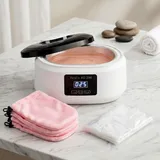
Gentle protocol: paraffin bath and Raynaud's
Suitable settings
With Raynaud's syndrome, the skin can be more reactive to temperature changes. A few simple rules:
- Set the device to a gentle temperature, 45 to 48 °C (Low setting on the TheraDawn)
- Never dip frozen hands directly: let them return to room temperature for a few minutes first
- If you are coming out of an attack, wait for the end of the red phase before doing the treatment
The steps
- Preheat the paraffin 25 minutes in advance, until fully melted
- Warm your hands gently (light rubbing) before immersion if they are very cold
- Dip each hand 4 to 6 times, letting the wax set between each layer
- Wrap in a plastic glove then an insulating mitten
- Wait 15 to 20 minutes: the deep heat does its work
- Remove the wax, then immediately put on warm gloves to prolong the effect
The right timing
- In the morning: a session to start the day with warmed hands
- Before going out in cold weather: do the treatment, then put on gloves before stepping outside
- In the evening: to relax the hands and promote a good night's sleep
Beyond the paraffin bath: the right anti-Raynaud's reflexes
The paraffin bath fits into an overall lifestyle to limit attacks:
- Cover up early: gloves from the first cold, several layers, a hat (we lose a lot of heat through the head)
- Avoid sudden changes: the supermarket freezer aisle, going from warm to cold
- Limit caffeine and tobacco: both contract the vessels and worsen Raynaud's
- Manage stress: strong emotions trigger attacks just as much as cold
- Move your hands: arm windmills, opening and closing the fists to restart circulation during an attack
When to see a doctor
The paraffin bath is a comfort treatment. Consult a doctor if:
- The attacks are very frequent, painful or affect only one hand
- You notice sores, ulcerations or skin that does not heal at the fingertips
- Raynaud's appears after age 40 or comes with other symptoms (joints, fatigue, hardening skin)
- You have doubts about the form of your Raynaud's (primary or secondary)
These signs may point to a secondary Raynaud's that requires assessment. The paraffin bath is still possible, but on medical advice.
Frequently asked questions
Can a paraffin bath cure Raynaud's syndrome?
No, the paraffin bath does not cure Raynaud's syndrome, which is a chronic vascular disorder. But it helps to deeply warm the hands, restart microcirculation and space out or shorten attacks. It is a complementary comfort treatment, not a medical cure.
What temperature should you use with Raynaud's?
Use a gentle temperature, around 45 to 48 °C (Low setting). With Raynaud's, the skin can be more sensitive to temperature changes. Excessive heat is pointless: it is the gradual, enveloping warmth that matters, not the intensity.
Is the paraffin bath dangerous with Raynaud's?
In the primary form (isolated Raynaud's, with no associated disease), the paraffin bath at a gentle temperature is safe and brings real comfort. However, if your Raynaud's is linked to a disease (scleroderma, lupus) or comes with sensory disturbances, ask your doctor before using it.
How many sessions per week for less cold hands?
In winter or during periods of frequent attacks, 3 to 5 sessions per week provide lasting comfort. Many people do a session in the morning to start the day and one in the evening to relax the hands. Adapt to how you feel.
Does the paraffin bath replace heated gloves?
No, the two are complementary. Gloves maintain heat throughout the day, the paraffin bath provides deep, targeted warmth that restarts circulation. Doing a paraffin bath before going out, then putting on gloves, is a very effective combination.
Does the paraffin bath also help cold feet from Raynaud's?
Yes. Raynaud's syndrome often also affects the toes. The protocol is identical: dip the foot 4 to 6 times, wrap in a bag and an insulating sock, and let it work for 15 to 20 minutes. The deep heat warms the extremities more lastingly than a simple hot water bath.
Disclaimer: this article is provided for informational purposes only and does not replace medical advice. If you experience persistent pain, consult your doctor or physiotherapist.