Paraffin bath and wrist and finger tendinitis
The paraffin bath relieves wrist tendinitis, De Quervain's and trigger finger. Thermotherapy, physio protocol and complementary exercises.
Wrist pain when turning a door handle, fingers that lock up in the morning, a sensitive thumb base at the slightest movement: tendinitis of the hand and wrist has become a silent epidemic. It affects computer workers, athletes, musicians and anyone who uses their hands repetitively.
The paraffin bath is one of the most widely used tools in physiotherapy to relieve these tendinitis conditions. The deep heat it provides reduces pain, softens the tendons and prepares the tissues for rehabilitation. Here is how it works, when to use it and which protocol to follow. For the basics, see our complete paraffin bath guide.
Hand and wrist tendinitis: understanding to treat better
What is tendinitis?
Tendinitis is an inflammation or degeneration of a tendon, the fibrous structure that connects muscle to bone. When a tendon is overused (repetitive movements, unsuitable posture, unusual effort), it becomes irritated, swells and painful.
The most common hand and wrist tendinitis conditions are:
- De Quervain's tendinitis: affects the thumb tendons (abductor pollicis longus and extensor pollicis brevis). Pain at the base of the thumb, worsened by pinching or twisting movements
- Trigger finger: the flexor tendon catches in its sheath. The finger locks in flexion then releases with a "click"
- Wrist extensor tendinitis: pain on the top of the wrist, common among mouse users
- Medial epicondylitis (golfer's elbow): pain on the inside of the elbow radiating to the wrist, linked to repeated pronation movements
Why computer workers are the most affected
8 hours a day on a keyboard and mouse impose thousands of repetitive micro-movements on the finger and wrist tendons. The static position keeps the muscles under constant tension without ever fully relaxing them. Over the weeks, the tendons become irritated, the synovial sheaths inflame and the pain sets in.
The problem: these tendinitis conditions are often ignored until they become chronic. The mild pain at the start becomes morning stiffness, then functional limitation. This is where the paraffin bath steps in to break this cycle.
How the paraffin bath relieves tendinitis
Thermotherapy: a recognised treatment in physiotherapy
Heat has been used for decades in rehabilitation to treat chronic and subacute tendinitis. Its mechanism of action is well documented:
- Vasodilation: the blood vessels dilate, increasing blood flow to the painful area. More blood means more oxygen and nutrients for tissue repair
- Muscle relaxation: the heat reduces the excessive muscle tone that often accompanies tendinitis. The tense muscles around the tendon relax
- Increased elasticity: the collagen fibres of the tendon temporarily become more supple under the effect of heat, which reduces stiffness
- Pain-relieving effect: heat activates the skin mechanoreceptors that "close the gate" to pain transmission (gate control theory)
Why paraffin is superior to other heat sources
The paraffin bath is not a simple hot water bath. Paraffin has a unique physical property: it transfers heat much more slowly than water. Which means:
- The heat penetrates gradually and deeply, reaching the tendons beneath the skin
- The temperature stays stable throughout the treatment (no cooling down like with a hot water bottle)
- Contact with the wax is bearable at temperatures (48 to 52 °C) that would be painful in water
- The complete envelopment of the hand ensures uniform diffusion across all the tendons
It is for these reasons that physiotherapists prefer the paraffin bath to hot compresses or water baths for treating hand tendinitis. For more details on physiotherapy use, see our article on joint pain.
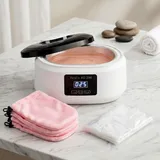
Protocol: paraffin bath for wrist tendinitis
When to use the paraffin bath
The paraffin bath is indicated in the following situations:
- Subacute tendinitis (after the first 72 hours): the acute inflammatory phase has passed, the pain persists but the swelling has decreased
- Chronic tendinitis: pain established for more than 6 weeks, morning stiffness, limited movement
- Before rehabilitation exercises: the heat prepares the tendons and reduces pain during stretches
- At the end of the day: after a day of computer work, to relax the overused tendons
The step-by-step protocol
- Preheat the device: switch on the TheraDawn 25 minutes before the treatment. The paraffin must be fully melted and at the right temperature (48 to 52 °C)
- Dip the hand and wrist: immerse slowly, including the wrist up to the start of the forearm. Hold for 2 to 3 seconds, remove, let set, then dip again. Repeat 5 to 6 times
- Wrap: slip on a plastic glove then the insulating mitten. Rest the arm on a cushion, hand relaxed
- Wait 20 minutes: do not move the fingers during the rest. Let the heat penetrate deeply
- Remove the wax: it peels off in one block. Your tendons are now warmed and softened
- Move straight to the exercises: this is the ideal moment to do your rehabilitation exercises (see below)
Recommended frequency
- Treatment phase: 1 session per day, ideally in the evening, for 2 to 3 weeks
- Maintenance: 2 to 3 sessions per week to prevent recurrences
- As prevention: 1 to 2 sessions per week for at-risk people (repetitive work, intensive sport)
Exercises to do right after the paraffin bath
The paraffin bath makes the tendons temporarily more supple. This is the ideal window to work on mobility without pain. Here are the recommended exercises by type of tendinitis:
For De Quervain's tendinitis (thumb)
- Thumb stretch: fold the thumb into the palm, close the fingers over it and gently tilt the wrist towards the little finger. Hold for 15 seconds, 5 repetitions
- Thumb opposition: touch each finger with the thumb, one by one, forming an "O". 10 repetitions
- Active extension: open the hand wide, spread the fingers as far as possible, hold for 5 seconds. 10 repetitions
For trigger finger
- Gentle flexion-extension: slowly bend and straighten the affected finger, without forcing the release. 15 repetitions
- Extension stretch: place the hand flat on a table, gently press on the finger to fully extend it. Hold for 10 seconds
- Gripping objects: squeeze a soft ball (not hard) for 5 seconds, release. 10 repetitions
For extensor tendinitis (top of the wrist)
- Wrist flexion: arm extended in front, palm down, use the other hand to gently flex the wrist downwards. Hold for 20 seconds, 3 repetitions
- Wrist rotations: arm extended, make slow circles with the wrist. 10 in each direction
- Eccentric strengthening: hold a light weight (500 g), wrist at the edge of a table, raise the wrist (2 seconds) then lower it very slowly (5 seconds). 3 sets of 10
Preventing tendinitis: ergonomics and daily routine
The paraffin bath relieves, but prevention remains the best strategy. A few simple adjustments significantly reduce the risk of recurrence:
- Vertical ergonomic mouse: reduces forearm pronation, the main cause of extensor tendinitis
- Keyboard at elbow height: the wrists should not be in permanent extension
- Active breaks: every 45 minutes, do 30 seconds of finger and wrist stretches
- Preventive strengthening: 5 minutes of wrist exercises in the morning maintain tendon suppleness
- Weekly paraffin bath: even without pain, 1 session per week maintains tendon suppleness and prevents the build-up of stiffness
When to see a health professional
The paraffin bath is a complementary treatment. Consult a doctor or physiotherapist if:
- The pain persists after 4 weeks despite rest and treatment
- The finger stays locked and no longer releases spontaneously
- You feel permanent tingling or numbness (possible carpal tunnel syndrome)
- The wrist swells visibly and feels warm to the touch
- The pain regularly wakes you at night
Frequently asked questions
Can a paraffin bath cure tendinitis?
No, the paraffin bath does not cure tendinitis. It relieves pain, reduces stiffness and prepares the tendons for rehabilitation exercises. It is a complementary treatment that fits into an overall approach (relative rest, exercises, ergonomics).
Can you use a paraffin bath during the acute phase of tendinitis?
During the acute phase (the first 48 to 72 hours, with sharp pain and sometimes swelling), prefer cold (an ice pack for 15 minutes). The paraffin bath is better suited to the subacute and chronic phase, when the pain is established but the acute inflammation has passed.
How many sessions before you feel relief?
Most users feel relief from the first session: the fingers are more supple, the wrist less stiff. For a lasting effect on chronic tendinitis, plan for 2 to 3 sessions per week for 3 to 4 weeks.
Paraffin bath or hot water bath for tendinitis?
The paraffin bath is clearly superior. Paraffin transfers heat 6 times more slowly than water, which allows gradual, deep warming without any burn risk. Hot water cools quickly and does not penetrate as deeply into the tissues.
Is the paraffin bath compatible with a wrist splint?
Yes. Remove the splint for the treatment, do your 15 to 20 minute paraffin bath, then put the splint back on top. The treatment does not interfere with wearing the brace. Some physiotherapists recommend doing the mobilisation exercises right after the bath, before putting the splint back on.
De Quervain's tendinitis: does the paraffin bath help?
Yes. De Quervain's tendinitis affects the thumb tendons (abductor pollicis longus and extensor pollicis brevis). The heat of the paraffin softens these tendons, reduces stiffness and makes the thumb-stretching exercises easier. It is a recognised complement to the brace and stretches.
Disclaimer: this article is provided for informational purposes only and does not replace medical advice. If you experience persistent pain, consult your doctor or physiotherapist.